DeutschEnglish
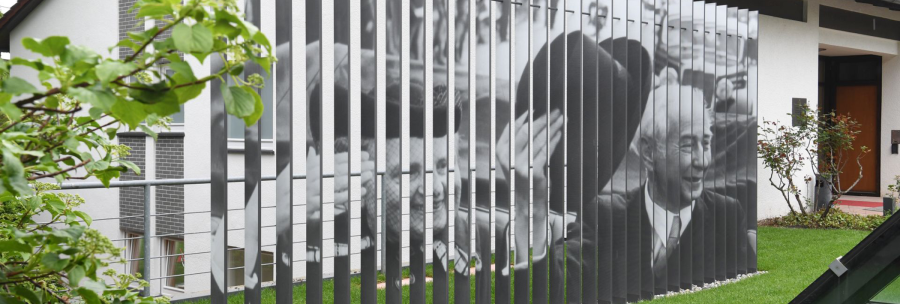
The Theodor-Heuss-Haus in Stuttgart is showing a photo installation with black and white images on vertical struts. Plants can be seen in the foreground., © Stiftung Bundespräsident Theodor-Heuss-Haus / Franziska Kraufmann
Interior view of the Theodor Heuss House in Stuttgart with exhibits, mannequins and information boards on the history of the office of the Federal President., © Stiftung Bundespräsident Theodor-Heuss-Haus / Franziska Kraufmann
Interior view of the Theodor Heuss House in Stuttgart with exhibits, information boards and a German flag., © Stiftung Bundespräsident Theodor-Heuss-Haus / Franziska Kraufmann
1 of 3
1 of 3

Theodor Heuss House Stuttgart

This Way

in 2.3 Kilometer Start Route

„Des goht euch en Dreck an, wie i wohn!“ (“It's none of your damn business how I live") – these were the words with which Theodor Heuss greeted waiting photographers as he moved into his final home in Stuttgart’s Killesberg. Today this detached house, occupied from 1959-1963 by Germany’s first Federal President after he left office, is open to visitors. On the ground floor visitors can walk around Heuss’ lounge and dining-room and take a look at his study. These three inter-connecting rooms, reconstructed using original period furniture, offer a fascinating glimpse of life in the late 1950s.

After this introduction to Heuss the man, it is well worth moving down to the garden level of the house where a permanent exhibition traces the Life and Times of Germany’s first Federal President. This gives visitors the chance to gain a more personal perspective on abstract historical issues by viewing them through the prism of Heuss’ life.

A wide range of objects, sound recordings, photos and films brings history to life and offers a fascinating insight into key periods in Germany’s history: the Empire, Weimar Republic, National Socialism and the modern Federal Republic. Central to the exhibition is a consideration of the question: how could democracy be made to work in Germany? The exhibition never shies away from difficult questions, such as Theodor Heuss’ agreement (as a young member of parliament) to Hitler’s “Enabling Act” of 1933.

In addition to the permanent exhibition, there is also in-depth information on key figures, events and aspects of the 20th century and the house is also used as a venue for a variety of other cultural events.


Show moreShow less

Location & Contact

Theodor-Heuss-Haus
Feuerbacher Weg 46
70172 Stuttgart

Places of interests nearby

The Carl-Zeiss Planetarium Stuttgart with modern glass and steel architecture, advertising banners and a clear sky in the background., © Stuttgart-Marketing GmbH, Sarah Schmid

Carl-Zeiss Planetarium

in 1.2 Kilometer Willy-Brandt-Straße 25, 70173 Stuttgart

Hospitalkirche Stuttgart

in 463 Meter Hospitalstraße 20, 70174 Stuttgart
Memorial to the victims of National Socialism in Stuttgart

Mahnmal für die Opfer des Nationalsozialismus in Stuttgart

in 389 Meter Planie, 70173 Stuttgart
The Hans im Glück fountain in front of historic buildings. Parasols and figures can be seen in the foreground. The houses have red roofs and many windows., © SMG, takemyhearteverywhere

Quarter around the Hans-im-Glück Fountain Stuttgart

in 97 Meter Geißstraße, 70173 Stuttgart
The Altes Schauspielhaus at night, illuminated with colorful lights. The entrance is surrounded by historic buildings., © Schauspielbühnen Stuttgart

Altes Schauspielhaus (Old Playhouse)

in 270 Meter Kleine Königstraße 9, 70178 Stuttgart
An orchestra plays on a stage, with two harps in the foreground. The conductor stands in front of the musicians, who are reading sheet music., © Stuttgarter Philharmoniker

Stuttgarter Philharmoniker

in 295 Meter Leonhardsplatz 28, 70182 Stuttgart

Theater Atelier

in 2.7 Kilometer Stöckachstrasse 55, 70190 Stuttgart
Solitude Palace with baroque architecture, staircase and green meadow in the foreground. The sky is cloudy., © Kartin Lehr VIEL UNTERWEGS

Solitude Palace

in 6.9 Kilometer Solitude 1, 70197 Stuttgart
1 of 8
1 of 8



