

High Noon - Satellitenabsturz im Südpazifik
- Location:
- Universität Stuttgart: Institut für Raumfahrtsysteme (IRS) im Raumfahrtzentrum Baden-Württemberg (RZBW), Pfaffenwaldring 29, 70569 Stuttgart
- Date
- December 3, 2026, 5:30 PM
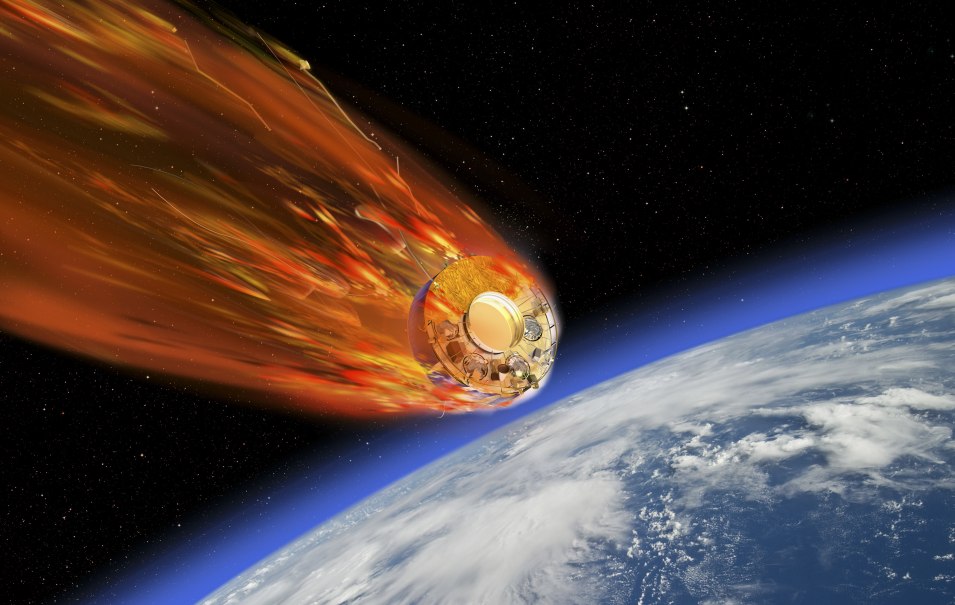
What happens when satellites return to Earth? Not all of them burn up completely. As part of the ESA’s ROSIE project, an international research team observed two re-entries within 24 hours. Stefan Löhle reports on exciting observations, innovative technology, and international collaboration.
End-of-life satellites, rocket parts, and resupply spacecraft are typically disposed of through a controlled reentry into Earth’s atmosphere. However, not all of these objects burn up completely: It has so far been difficult to predict whether and how much debris will reach the Earth’s surface. Larger spacecraft are therefore deliberately crashed into the Earth’s atmosphere over the sparsely populated South Pacific.
The HEFDiG (High Enthalpy Flow Diagnostics Group) research group at the IRS served as the scientific lead for the ESA project ROSIE (Re-entry Observation Setup and International Execution), in which an international team systematically observes such re-entries. The goal is to learn more about the burn-up process and its effects on Earth’s atmosphere and to gain insights for future spacecraft and their disposal.
Within just 24 hours, the team made two observations of satellites that burned up over the ocean around noon—High Noon in the South Pacific! Stefan Löhle reports on the mission, the observation technology used, and the results. He also discusses the collaboration among many small teams from a wide variety of disciplines, who together mastered an extraordinary observation task.
Stefan Löhle studied and earned his Ph.D. at the University of Stuttgart. After postdoctoral research stints at the University of Bordeaux, KIT, and the DLR, he has been conducting research at the IRS for 15 years now on atmospheric entry maneuvers into other planets. His research group, HEFDiG, brings together an experienced team of doctoral students and postdocs with proven expertise in optical measurement technology and the study of aerothermodynamics through aircraft-based observations. In addition, he heads the IRS’s plasma wind tunnel laboratories, which have offered internationally unique research opportunities since the institute’s founding in 1970 and are continuously being further developed.