

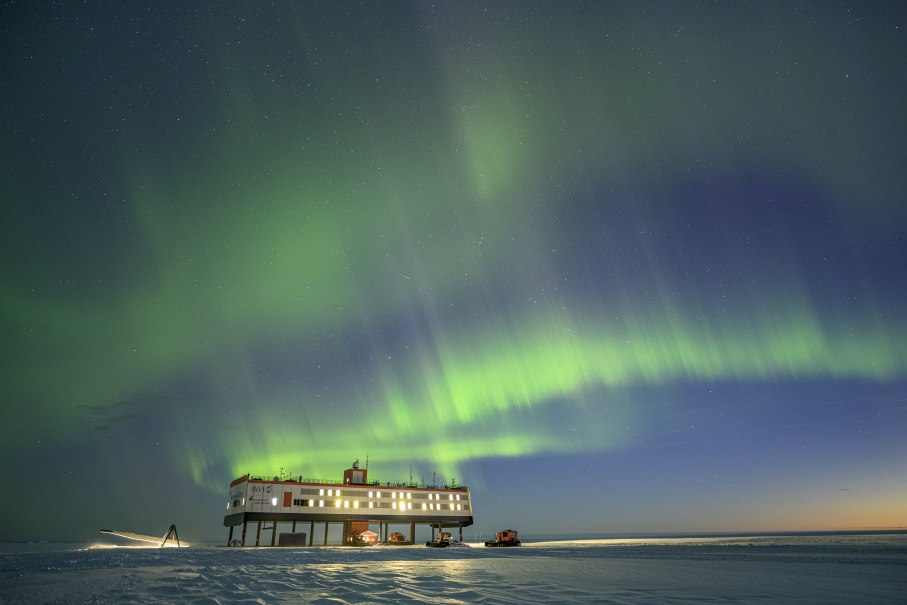
Raumstation im Eis – 13 Monate in der Antarktis
- Location:
- Universität Stuttgart: Institut für Raumfahrtsysteme (IRS) im Raumfahrtzentrum Baden-Württemberg (RZBW), Pfaffenwaldring 29, 70569 Stuttgart
- Date
- November 19, 2026, 5:30 PM
Life and Research at the End of the World: Lukas Weis recounts his 13 months at Neumayer Station III in Antarctica. Extreme cold, months of isolation, and fascinating natural phenomena make his talk a journey into a world that bears a striking resemblance to space travel.
What does a research expedition to Antarctica have in common with a mission in space? Surprisingly much: extreme isolation, limited resources, technical systems that must function reliably, and a small team living together in a very confined space for months on end. In an emergency, evacuation is more difficult than from the International Space Station (ISS). It is no coincidence, then, that Neumayer Station III is sometimes referred to as a kind of “space station in the ice.”
Temperatures of −50 °C, wind speeds exceeding 200 km/h, and more than eight months of complete isolation make a stay on the Antarctic ice shelf an extraordinary challenge. During the Antarctic winter night, the sun disappears for more than two months, and the nearest people live 300 kilometers away. During this time, a nine-person team keeps the station running—from electricity and water to food and the scientific program.
Lukas Weis experienced this firsthand. From November 2024 to December 2025, he was stationed at Neumayer Station III, where he managed the Trace Substances Observatory. About 1.5 kilometers south of the station, measuring instruments operate continuously, providing data on aerosols and greenhouse gases, among other things. Every day, he made his way to the measurement container on foot or on skis, as vehicles would have interfered with the sensitive measurements.
In his presentation, Lukas Weis takes the audience to the end of the world and shows what it’s like to live and work under conditions that, in many ways, resemble a space mission. How does one even get to Antarctica? How do you operate a research station in the ice? What do you eat when the nearest supermarket is more than 4,000 kilometers away? And how do you maintain decades-long measurement series under extreme conditions?
Added to this are fascinating glimpses of a unique environment: penguins, seals, giant icebergs, and the aurora—but also darkness, cold, and the experience of being cut off from the outside world for months on end. A personal insight into a world that bears a striking resemblance to space travel.
Lukas Weis studied physics and subsequently worked as a research assistant at the Alfred Wegener Institute in Bremerhaven. As part of this work, he spent 13 months in Antarctica. Today, he is pursuing his Ph.D. in climate physics at the Max Planck Institute for Meteorology.