Stadtspaziergang im Stuttgarter Westen
Quarter flirtation & church drama: the lake of fire
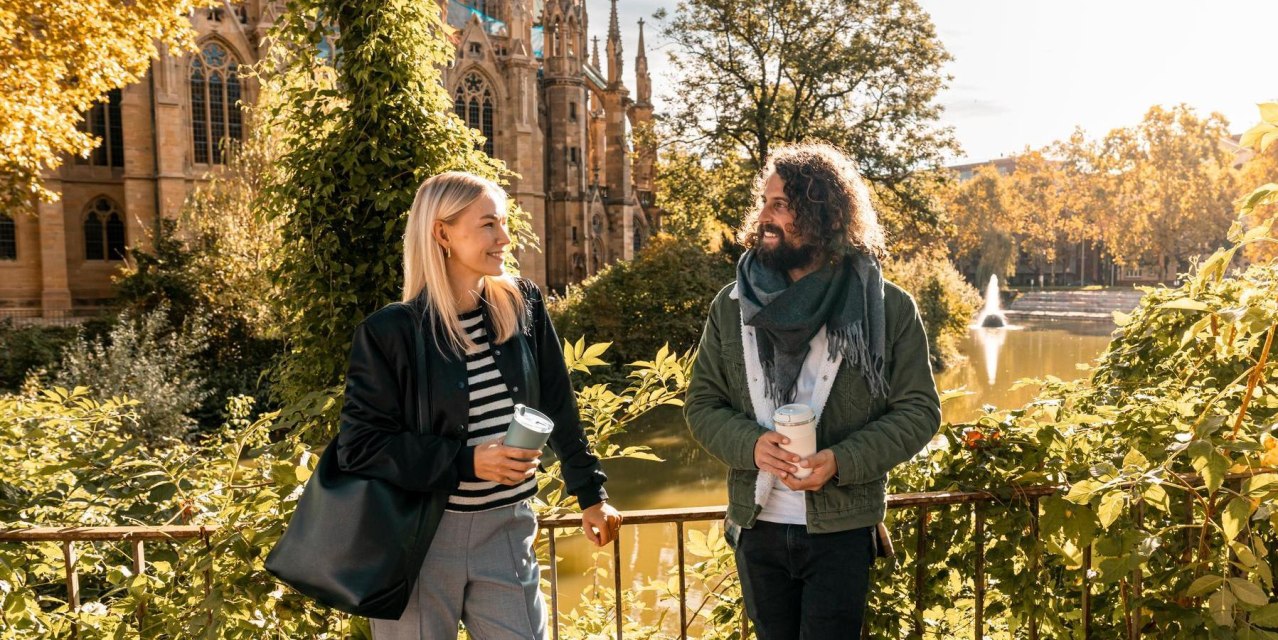
On its peninsula, St. John's Church strikes a dramatic neo-Gothic pose. The Second World War took the top off it, and as a memorial it remained without a spire after reconstruction. The lake of fire spills around it. There are benches and willows around the former fire-fighting pond and a flight of steps on the south side. Lovers canoodle, swans chatter, cold drinks sizzle. Shall we sit together comfortably... or is it time to go west? Go West?
Hobbit & theater: the Rotebühlstraße
Then we turn our backs on St. John's Church. Stories are hidden on the other side of the street - literally, because the complex at 77 Rotebühlstraße is home to the Klett publishing house. It is not only known for school books, but also for non-fiction, fiction, fantasy and science fiction. It was publisher Michael Klett who brought the "Hobbit" from the Shire to Swabia in 1969 and from there to the whole of Germany.
No, to the right, the "WWW" above the entrance portal of No. 83 does not take us to the Internet. "WWW" stands for "We want Waldbaur." Or rather: Waldbaur chocolate. Especially the famous "Katzenzungen". The sweet treat was once produced in the factory at Feuersee and eaten all over Europe and even in America.
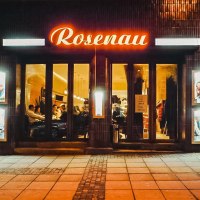
Our gaze wanders on to No. 89. Who is looking at us? It's the philosopher Arthur Schopenhauer. His oversized plaster bust adorns the canopy of the "Theater der Altstadt", one of the oldest private theaters in Baden-Württemberg. Speaking of small theaters: 250 meters away, at no. 109, the "Rosenau " serves its guests culinary delights in the front and cultural treats in the back, such as cabaret, comedy, readings and poetry slams. The "aus:sicht" evenings prove to be an unusual experience. In the dark restaurant, there is nothing for everyone to see, but all the more to taste, smell and hear.
Chemistry from Stuttgart & a company from around the world: Knospstraße
After walking along Rotebühlstraße to the right, we notice the "Villa Knosp " at no. 70/72. The wealthy Knosp family, who also had the neighboring Knospstraße built, once lived in the red brick building. We turn left into this former private street and now find ourselves where first the Knosp chemical factory and then Gustav Siegle's paint factory were located in the 19th century. Both companies eventually merged with the Badische Anilin- und Sodafabrik in Ludwigshafen. Today, BASF is the largest chemical company in the world.
St. Martin's geese & draught horses: Johann-Sebastian-Bach-Platz
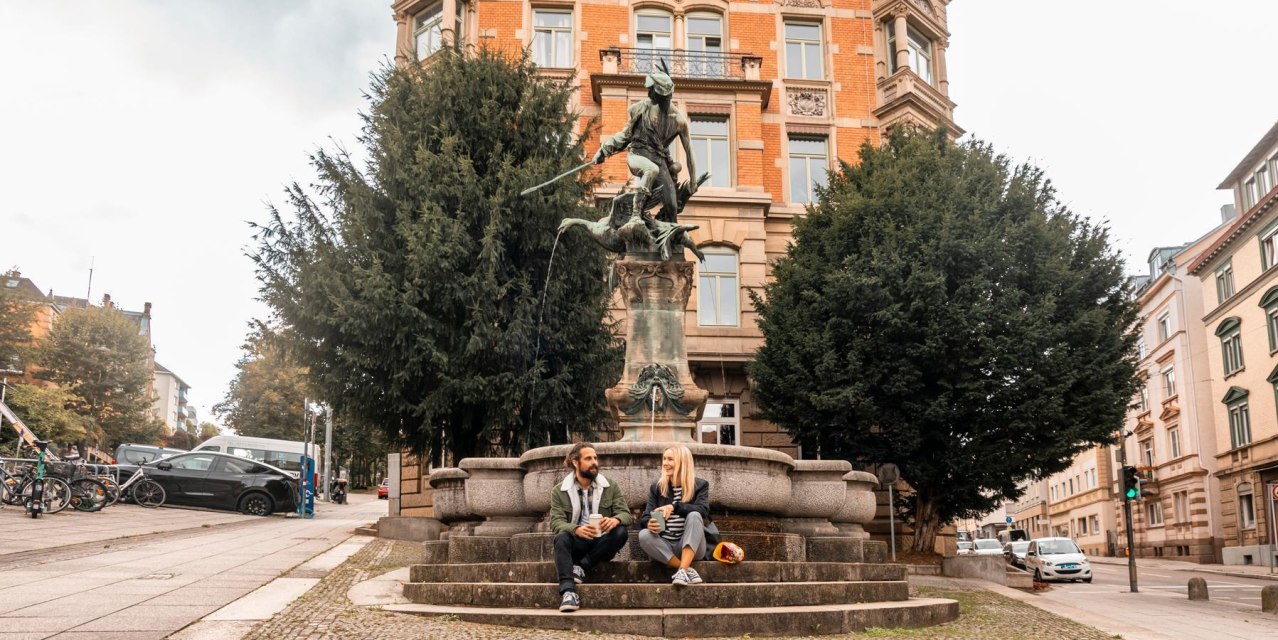
After Knospstraße, we turn right into Augustenstraße and left at the next junction into Hasenbergstraße. Here we head towards the acute-angled Johann-Sebastian-Bach-Platz, whose edges are adorned without exception with Wilhelminian-style buildings. The Gänsepeterbrunnen (Goose Peter Fountain ) from 1901 also attracts full attention. In the past, the crossroads served as a gathering place for draught horses; they were watered at the previous fountain before the arduous ascent towards the Black Forest. Today's fountain with the "Gänsepeter" is reminiscent of another urban scene: before St. Martin's Day, a large number of geese were once driven from the surrounding villages to the Stuttgart market. From the square, we walk up the Hasenbergsteige, just like the draught horses once did. But don't worry: the calf sport is short-lived.
Villa museum & record holder: the Hasenbergsteige, the Schwabtunnel
The few meters uphill are enough to catch sight of the first palatial residential buildings that line Hasenbergsteige. It was not for nothing that the steep street was popularly known as the "Prominent Hill" and "Villa Museum" when the city aristocracy settled there from the 20th century onwards.
At the corner of Villa Kaiser at Hasenbergsteige 20, we see the bust of Stuttgart pastor, professor and poet Gustav Schwab. His retelling of the "Legends of Classical Antiquity" has influenced generations of schoolchildren. The Schwab Tunnel, which runs beneath our feet next to the villa, is named after the author. The 125-metre-long tube through the Hasenberg was built in 1896 to connect the working-class district of Heslach in the south with the factories in the west. The Schwabtunnel has already broken many records: when it was built, it was the widest tunnel in Europe. In 1900, a car chugged through a tunnel here for the first time in the world. From 1902 to 1972, streetcars, horse-drawn vehicles, cars, bicycles and pedestrians passed through it simultaneously. It was also the first tunnel with mixed traffic.
We descend the steps on both sides of the portal and follow Schwabstraße to the crossroads. Before turning left into Reinsburgstraße, we turn around and look into and over the maw of the Schwabtunnel. It is adorned with sandstone work such as a lion's head and the Stuttgart city coat of arms.
Large checkered & densely built-up: Rötestraße & Co
After a short walk along Reinsburgstraße, we turn right again into Rötestraße. From there, we stroll straight ahead for 500 meters. On this route, it quickly becomes clear that the five- to six-storey Wilhelminian-style houses made of sandstone and brick are the district's trademark. This was not always the case. Until the 19th century, vineyards, meadows and fields characterized the west of Stuttgart. It was only with industrialization that the urban boom and development of the area began. Initially, companies such as the chocolate manufacturer Waldbaur or the BASF predecessors Siegel and Knosp settled here. We heard about them at the beginning of our tour. Between 1850 and 1920, the street network on the valley floor became square, practical and well-built. The Wilhelminian-style blocks of flats were built, transforming Stuttgart-West into one of the largest contiguous areas of old buildings and the most densely populated residential areas in Germany to this day. We walk straight ahead on this chessboard until we reach the junction of Rötestrasse and Paulusstrasse. Mythical creatures, animals, plants: Many facades stand out with their ornamentation. On the corner building facing Paulusstraße, the balcony is even supported by two elephant heads. The fact that the buildings were decorated at the front was at the king's request. The rear sides, on the other hand, appear plain. For the front-back comparison, let's walk around the block, left into Paulusstraße, then right into Seyfferstraße.
Backyard & farm: the Rossbollengässle
Here we get to know a prime example of traditional perimeter block development from 1874. This refers to the arrangement of several residential buildings around a shared inner courtyard. Due to this street planning, the west is teeming with backyards. We enter the most famous one between Seyfferstraße 64 and 66, where a sign points to Rossbollengässle. Slipped in!
Here we are: the buildings around the large inner courtyard are close together. Their backs are made of unadorned brick, while their fronts put on a show with animal and ornamental details. This inner courtyard hides another secret: the urban square with play equipment, table football and loungers was created on the roof of an underground car park and is the result of a residents' initiative. But how did the name Rossbollengässle come about? Until the Second World War, the area was home to the last inner-city farm with pigs, chickens... and horses!
We leave the secret spot via the exit on Rötestraße and turn left. The next crossroads surprises us with the ornate Gutbrodhaus. We turn right into Vogelsangstraße.
Brick & letters: Bismarckplatz
A large, neo-Romanesque brick church soon rises up on the left. A wealthy merchant donated its construction in 1901 after the death of his eleven-year-old daughter Elisabeth, which is why the church was also dedicated to St. Elisabeth. Bismarckplatz lies at the feet of St. Elisabeth. For some years now, it has been the focus of urban development issues as a district center. The neighborhood is bustling all around. As soon as the sun heats up the asphalt, the hip West conquers the terraces of the "Metzgerei", the "Pinsa Manufaktur" and other eateries. Families meet singles, Swabianism meets everyman. The cute "Buchstäbchen " takes you on fantastic journeys with its children's books, while the "Allesraum" next door entices you with graphics and stationery, gift items and lifestyle reading material. Fancy a break?
School & barracks: Schwab-/Bebelstraße
Refreshed, full and inspired, we set off again along Schwabstraße until we reach the tram line. At the "corner of Schwab and Bebel", as the locals call the junction, the magnificent Schwabschule has been standing since 1900. When it was opened, its architect Emil Mayer is said to have argued that a school building should not only focus on practicality, but also on beauty, "in order to awaken a sense of art in children at an early age". The modern Moltke site is located diagonally to the Schwabschule. From 1886 to 1966, the castle-like Moltke barracks stood in its place.
Old model & new west: the Olga area
We follow the streetcar line to the right in Bebelstraße and finally turn left into Hasenbergstraße. At the newly created Olgaplatz, the children from the neighborhood romp around in a real luxury playground. Climbing hills, bouncy mushrooms and a bird's nest swing herald the modern Olga area, which has been created on the site of the former Olga Hospital "Olgäle". Here, the typical perimeter block development has been rethought and brought into the 21st century with four green inner courtyards. The block contains around 220 apartments, a daycare center, a family and neighborhood center, underground parking and commercial space. A path crosses the site from north to south. This takes us to Senefelderstraße. Turn right here. At no. 58, we pass the "Moulu". The corner café with the striped awnings is one of the many sweet spots in the district that tempt you to have a coffee and a brunch.
Prison & guillotine: the former penitentiary
In the inner courtyard of Senefelderstraße 45, things get curious. The residential building there was once... a prison. In the middle of the 19th century, there was a lot of free building land in the area apart from the nearby Feuersee. So in 1850, it was decided to build the so-called Pönitentiarhaus far away from the town center. 120 life prisoners carried out their work here. Three executions by guillotine even took place here. The central building and administrative wing of the penitentiary still stand. They were converted into a residential building in the 1980s.
Ex-boulevard & district axis: Johannesstraße
We head towards Johannesstraße via Ludwigstraße. King Wilhelm I had the latter built as a "Swabian boulevard" based on the Parisian model. Isolated Wilhelminian-style buildings, avenue trees and the street layout - with a carriage lane, three meters for riders (today: parking spaces) and two meters for strolling - are still reminiscent of the old splendour. Above all, the harmonious visual axis is striking: Johannesstraße heads straight towards Johanneskirche and Feuersee. We can end our little ramble there. Or we can embark on a leisurely escapade. This takes us from the valley and its chequered streets to the western slope with its views, chic houses... and an onion dome in the residential area.
Condition of the path
Details
- J
- F
- M
- A
- M
- J
- J
- A
- S
- O
- N
- D