
"Mittendrin spazieren" – Kleiner Streifzug
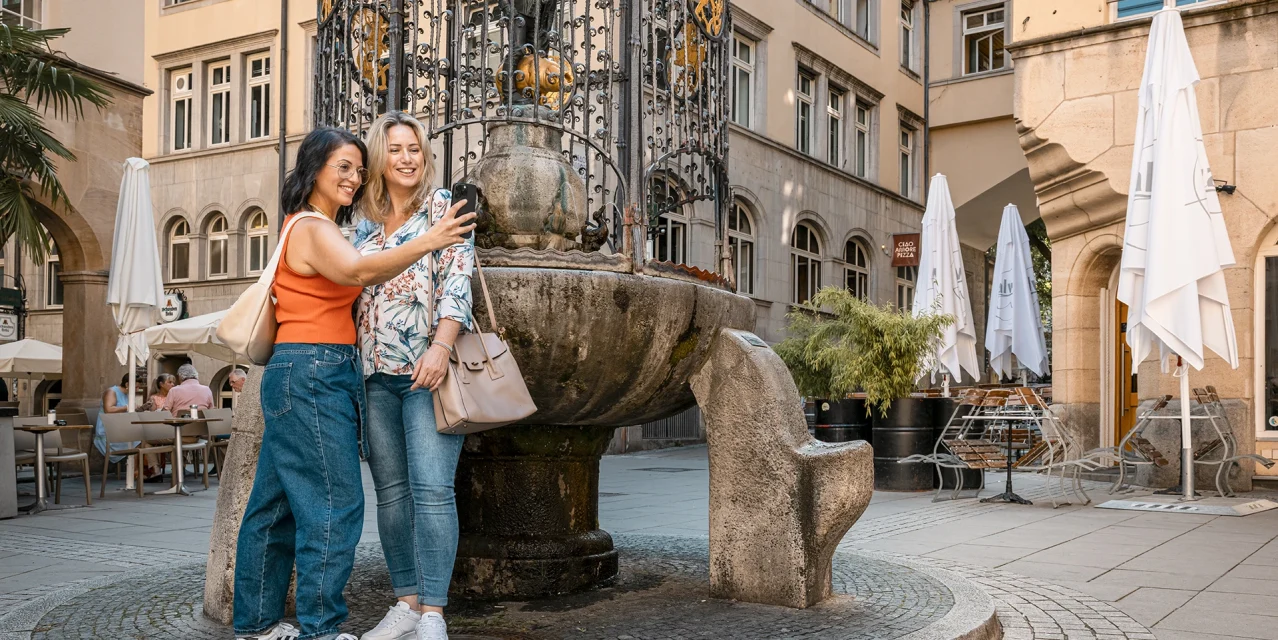
Bunker hotel & fountain: the market square
Shoes laced up, we start our tour at the market square. Stuttgart highlights such as the wine village, Christmas market and weekly market regularly ensure a good mood in front of the town hall. All around are traditional stores such as the luxury department store Breuninger and the household goods specialist Tritschler - the oldest retailer in Stuttgart. Beneath our feet is a mineral spring that still feeds the historic market square fountain. And who would have thought that there is also a bunker hotel hidden underground, which was one of the largest hotels in the city after the Second World War?
Paternoster & panorama: the town hall
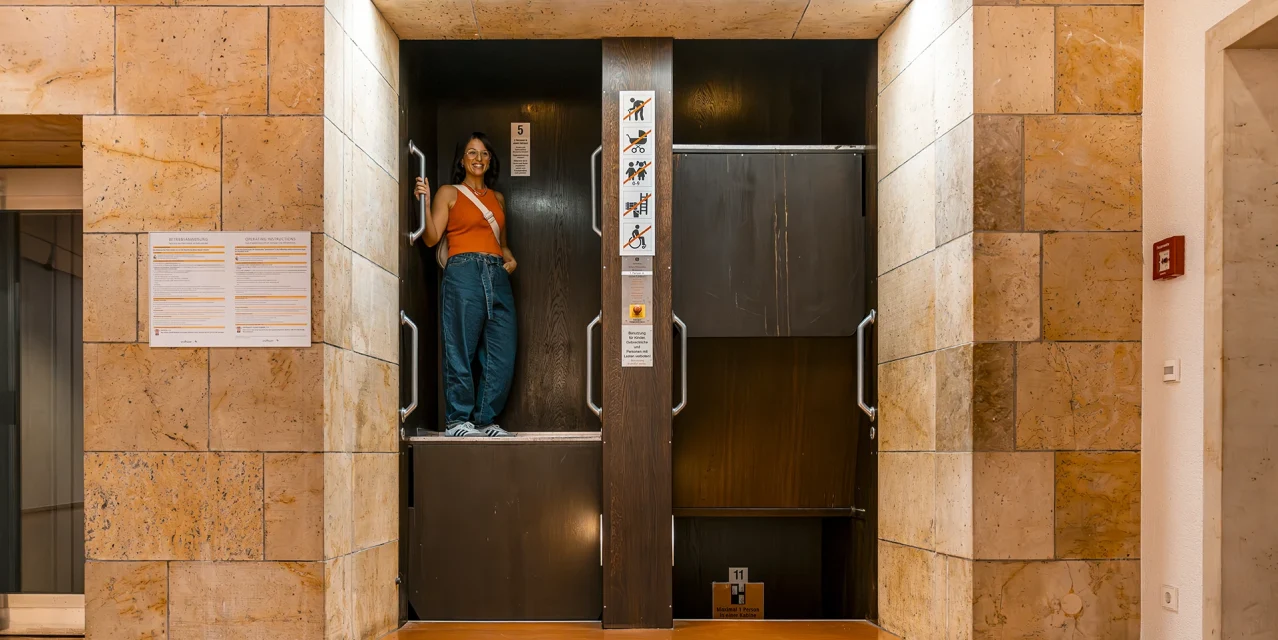
The eventful history of the town hall can be read from its façade: It's old at the back, new at the front. If you're wondering what the front once looked like, peek around the corner on the right. There, the 2.41-metre-tall Stuttgardia is holding a miniature of the late Gothic town hall from 1905 in her hands. Ciao wallflowers, we are now entering the town hall. Inside, an old paternoster makes its rounds and the carillon in the tower chimes five times a day. From the panoramic window on the 4th floor, we look out over our next destinations. Behind the colorful houses on the market square, the gleaming facades of the Dorotheen Quartier rise up on the right, the Old Palace and the market hall in the middle and the collegiate church on the left.
Luxury & architecture: the DOQU
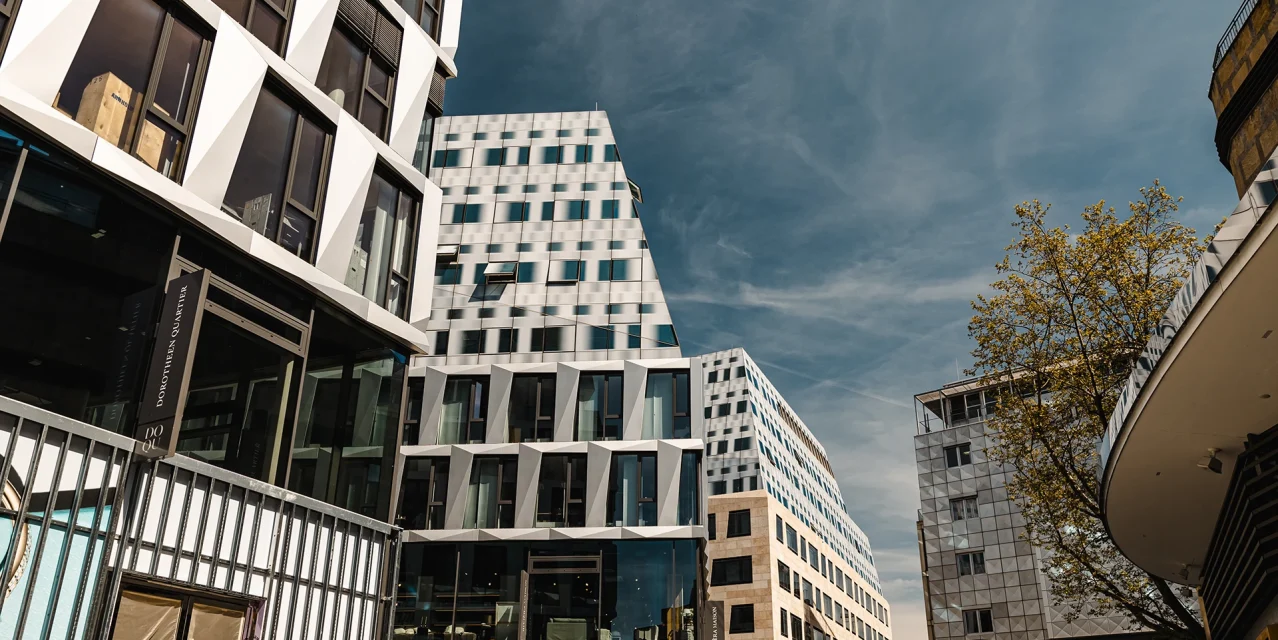
With the town hall behind us, we cross the market square and head towards Sporerplatz via Münzstraße. In this elegant "new center", historic and futuristic buildings face each other: on the right, the Dorotheen Quartier (DOQU) attracts visitors with luxury brands such as Rolex, Steiff and the first interactive Porsche Brand Store. Bent and folded façades made of limestone, aluminum and glass create contrasts. The buildings, some of which are nine storeys high, are cleverly integrated into the urban structure and open up historical lines of sight. For example, we can see the towers of the collegiate church when we turn around.
Great on the outside & delicious on the inside: the market hall
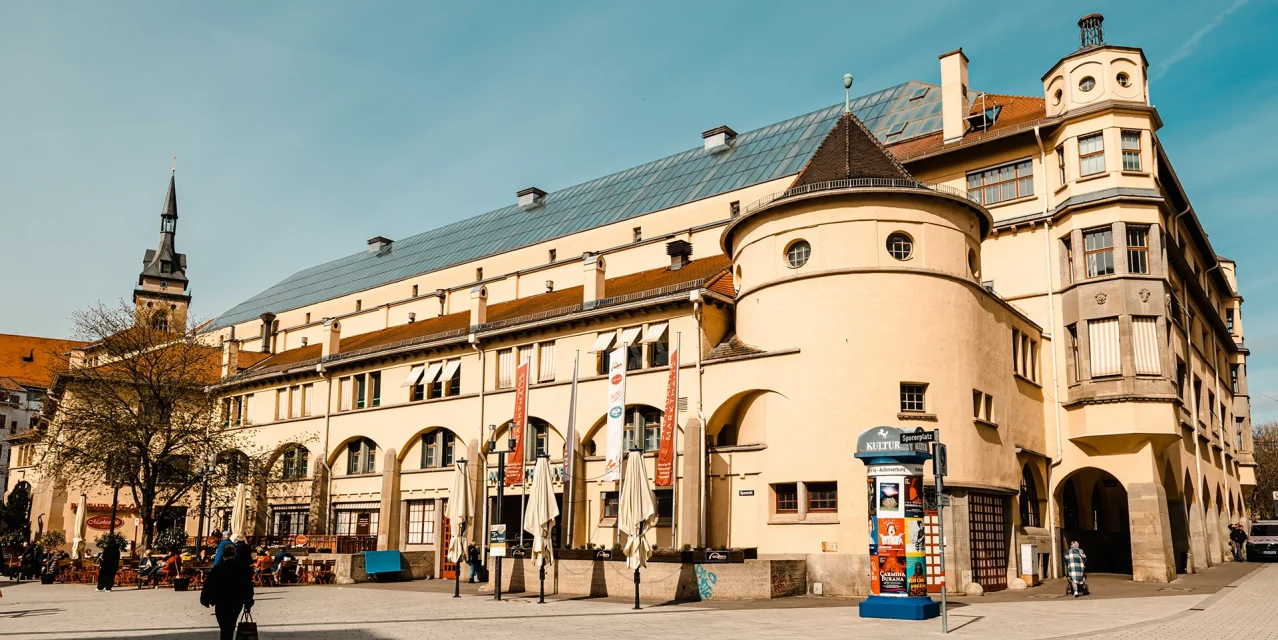
Directly on the corner of Sporerplatz, the market hall from 1904 catches our eye. Arcades, bay windows and glass roofs: this architectural gem is home to the city's temple of delicacies. Come on in! Delicacies from all over the world are sold at more than 30 stalls. From the gallery of the Empore restaurant, we can admire the land of milk and honey from above. Tip: The Merz & Benzig department store, a top address for exquisite gifts, also extends over three floors. We leave the market hall on Sporerstraße and walk to the right in the direction of the collegiate church. At Kirchstraße, we turn right again. Tip: At this corner, Stuttgart institutions such as the "Holanka-Bar" or the "Café Nast" tempt you to take a coffee break.
Historic deal & faithful tower bell ringers: the collegiate church
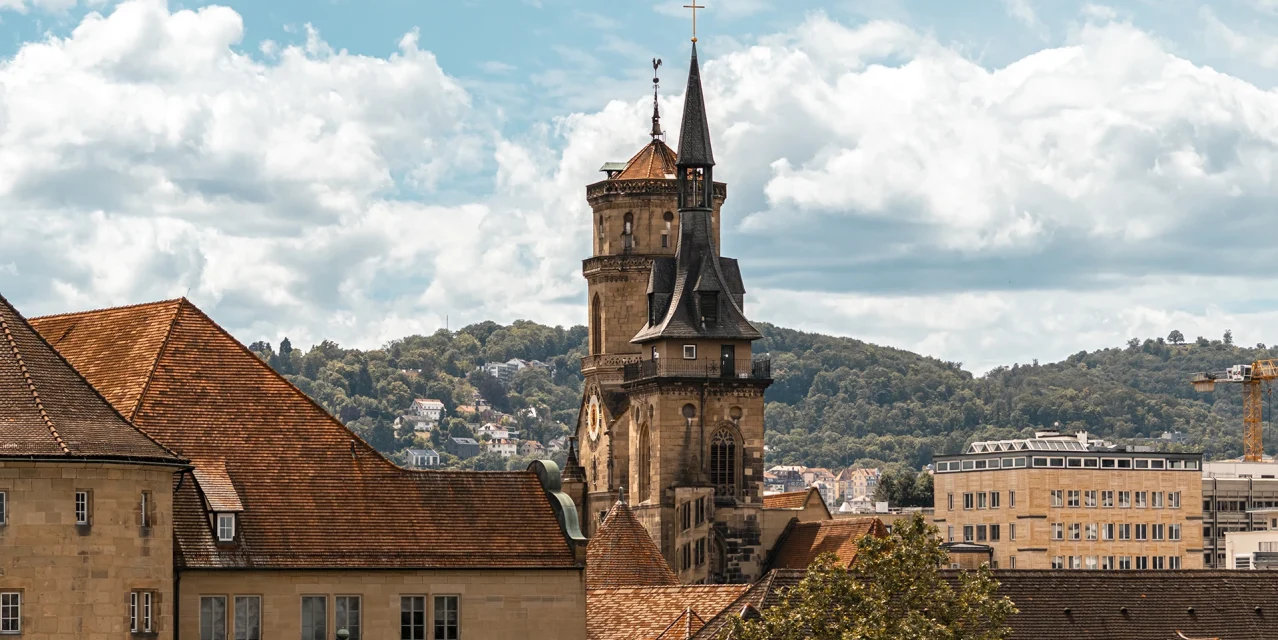
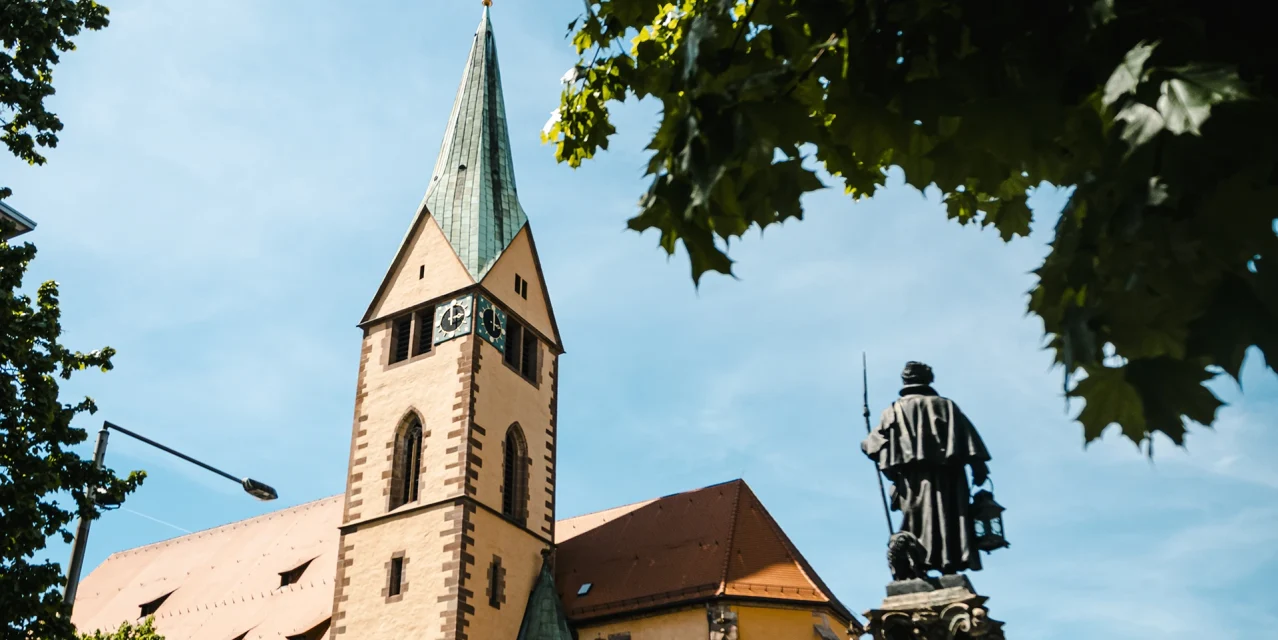
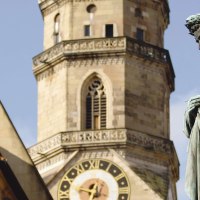
We stroll along Kirchstraße to Schillerplatz and pass the collegiate church. Thanks to a historic deal, it is (almost) the tallest church far and wide. On Tuesdays and Thursdays, the tower blowers climb the west tower and play their songs over the rooftops of the city center. This has been a tradition for over 400 years.
Poets & flowers: Schillerplatz
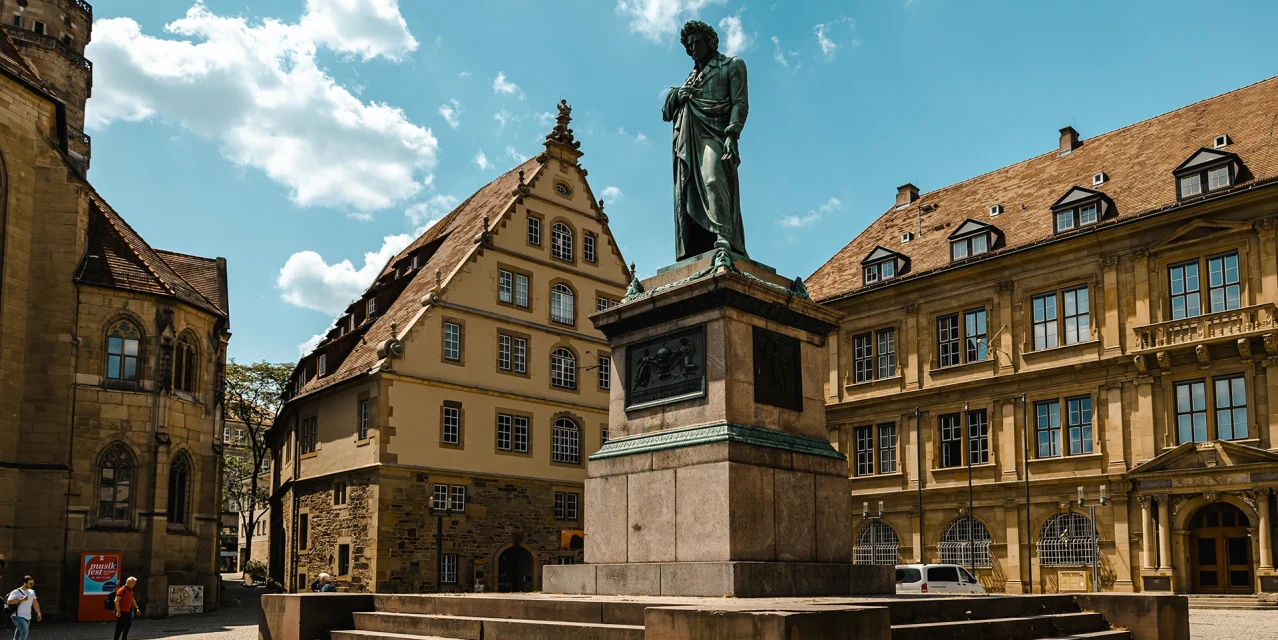
On Schillerplatz, we close our eyes and imagine the clattering of horses: Stuttgart's origins, the eponymous "Stutengarten", are said to have been located here. But now open your eyes. Because on Schillerplatz, the Collegiate Church, Fruchtkasten, Prinzenbau, Alte Kanzlei and Altes Schloss perform their façade ballet. On market days, it is at its most beautiful when Germany's first Schiller statue gazes dreamily at the flower and vegetable stalls. Tip: If you love hidden details, take a walk around the Fruchtkasten. At the corner of the building facing away from the square, the Hutzelmännlein plays his jokes. Who knows the fairy tale about the Stuttgart goblin?
Arcades & history: the Old Palace
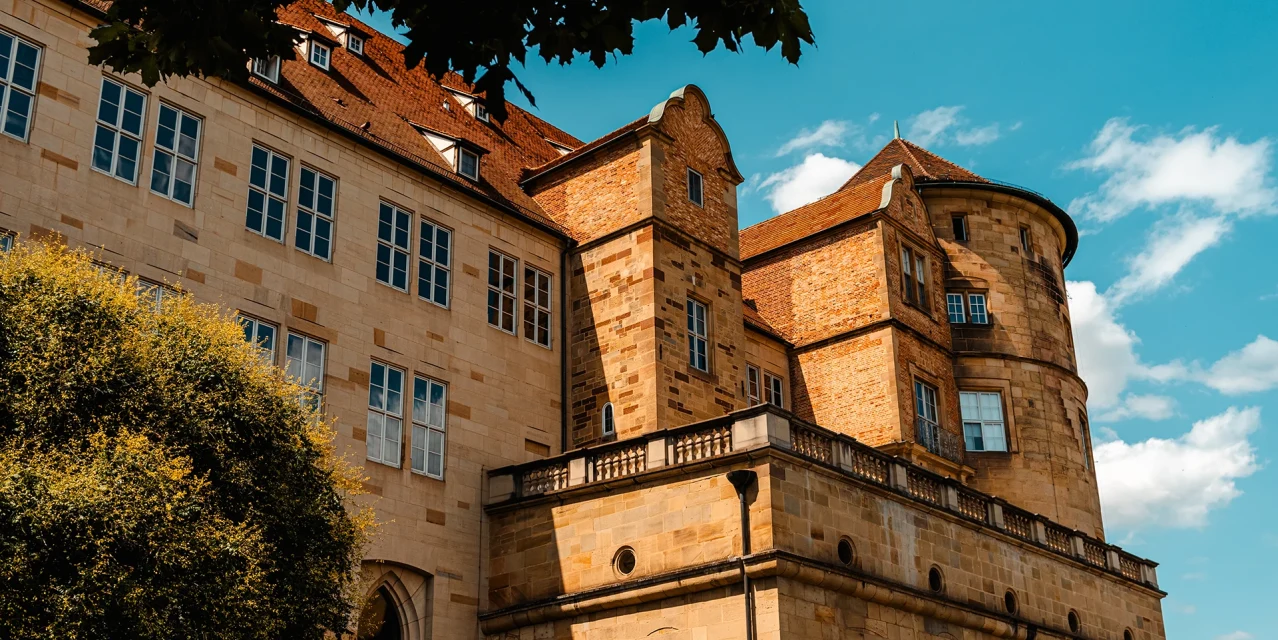
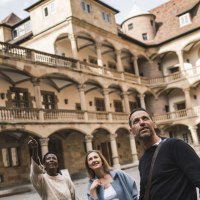
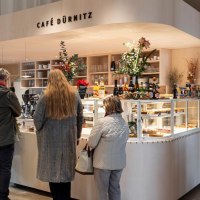
Now we enter the inner courtyard of the Old Palace. The father of the state, Duke Eberhard im Bart, watches us as we stroll through the arcaded courtyard. From moated castle to Renaissance palace: if only these walls could talk! They can: History comes alive in the State and Children's Museum. Tip: City knights can take a breather in the "Dürnitz" café-lounge. We leave via the same entrance. We leave Schillerplatz via the Kanzleibogen. Like the locals, we use this baroque passageway as a shortcut to Königstraße.
Shopping & Körble: the Königstraße
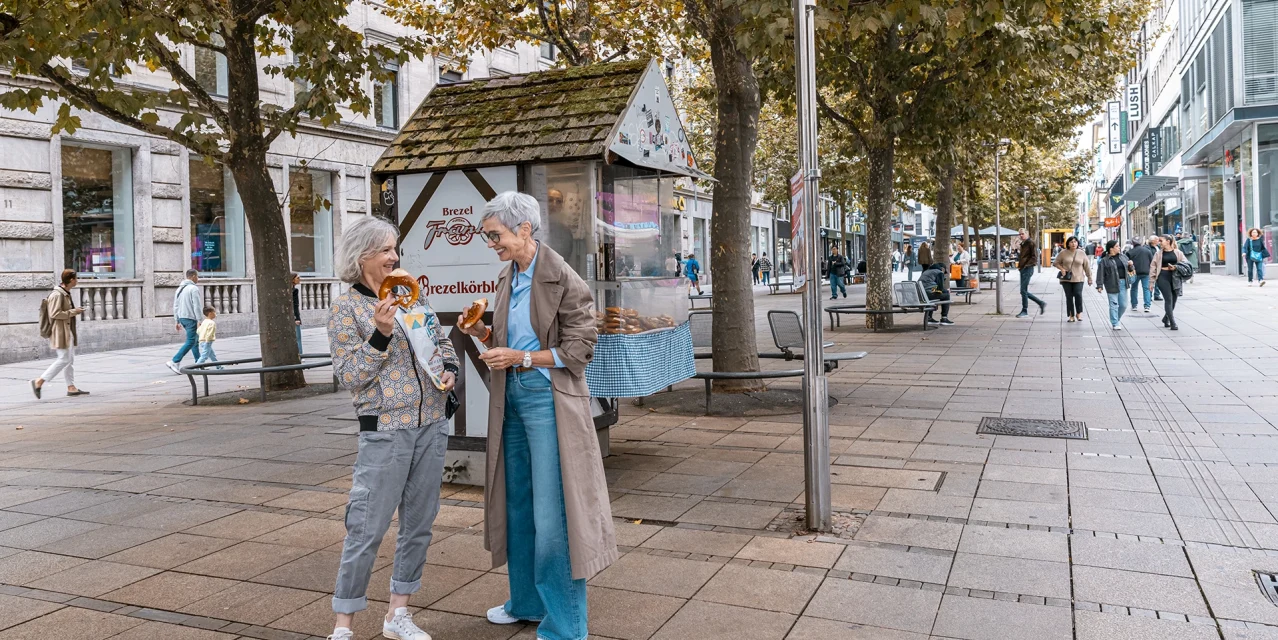
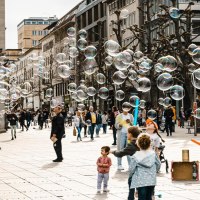
Lots going on here! After all, we are on Stuttgart's longest shopping street. Königstraße stretches 1.2 kilometers from the main train station to the city center. Halfway along, it passes Schlossplatz. To the right, it welcomes us with lawns, charm and fountains. Tip: The pretzel to go at the iconic Brezelkörble. One is located on Königstraße right at the height of the Kanzlei arch.
Jubilee column & façade ballet: the Schlossplatz
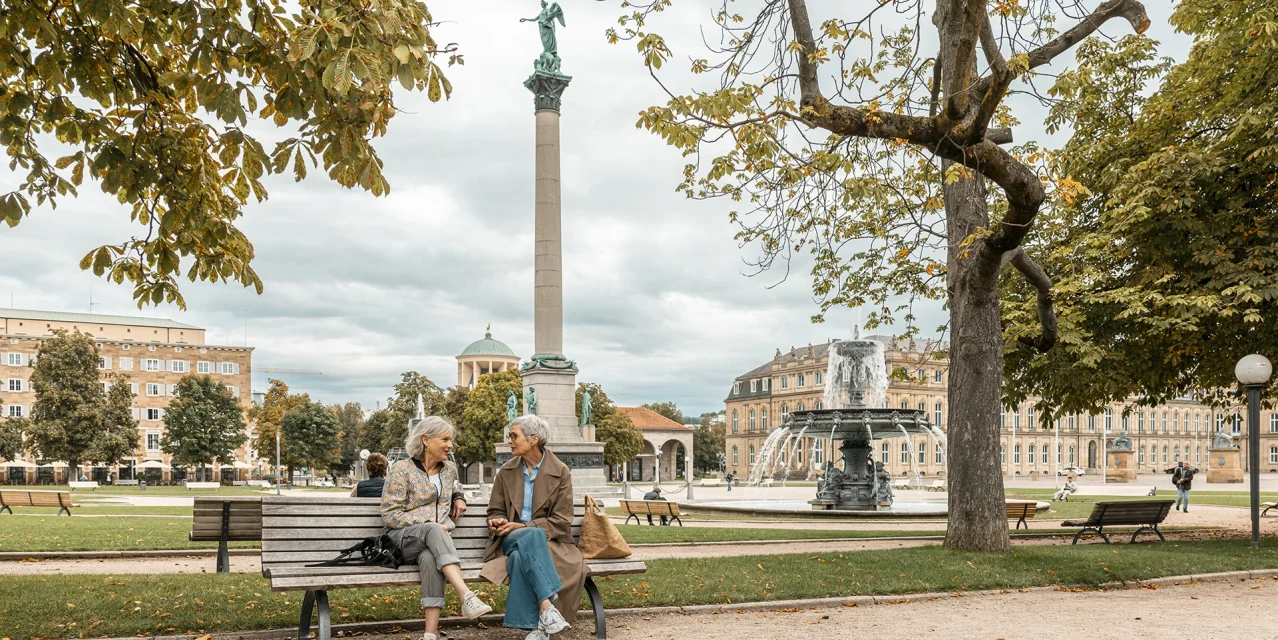
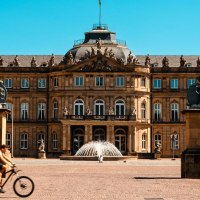
The New Palace shows the way: All the facades on the Schlossplatz are dressed up. The spectacle looks best in the middle of the square next to the Jubilee Column. Here we turn in a circle and experience seven centuries of Stuttgart's architectural history.
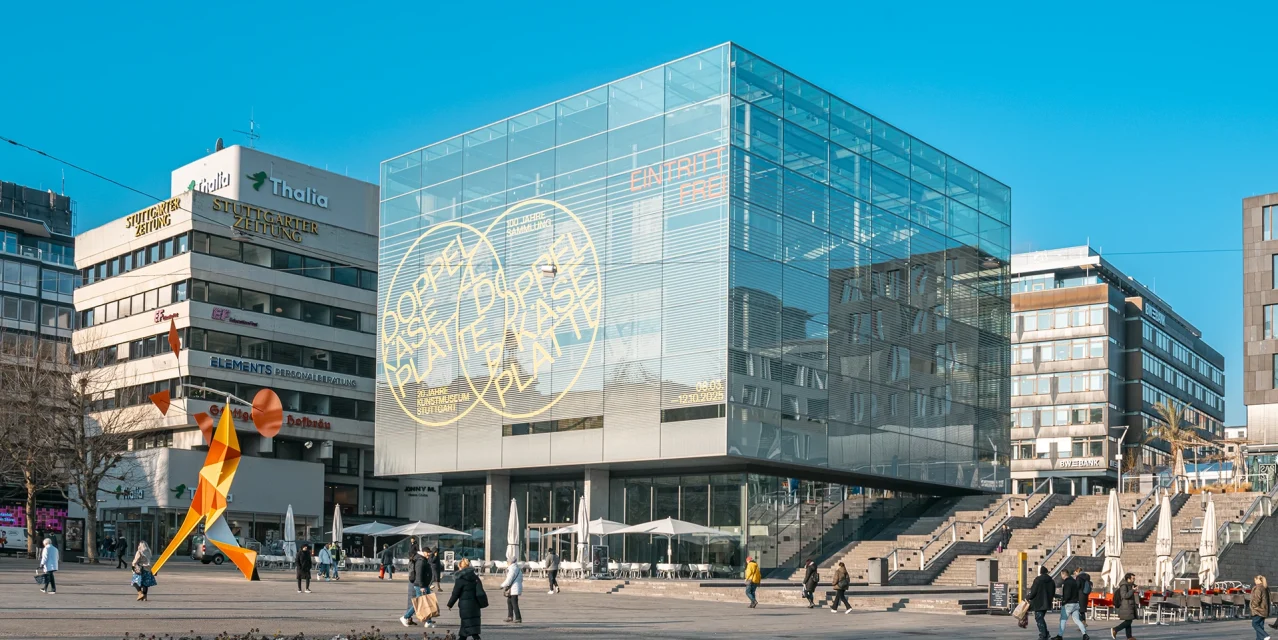
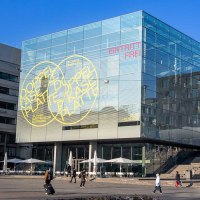
Cube & view: the art museum
After the spin is before the flight of fancy: that's why we enter the Kunstmuseum Stuttgart. In the glass cube, we climb (free of charge) to the 4th floor and marvel at the Schlossplatz from above. Neighborhood fact: Duke Carl Eugen had the New Palace built in 1744 as an "adequate (...), sufficient dwelling".
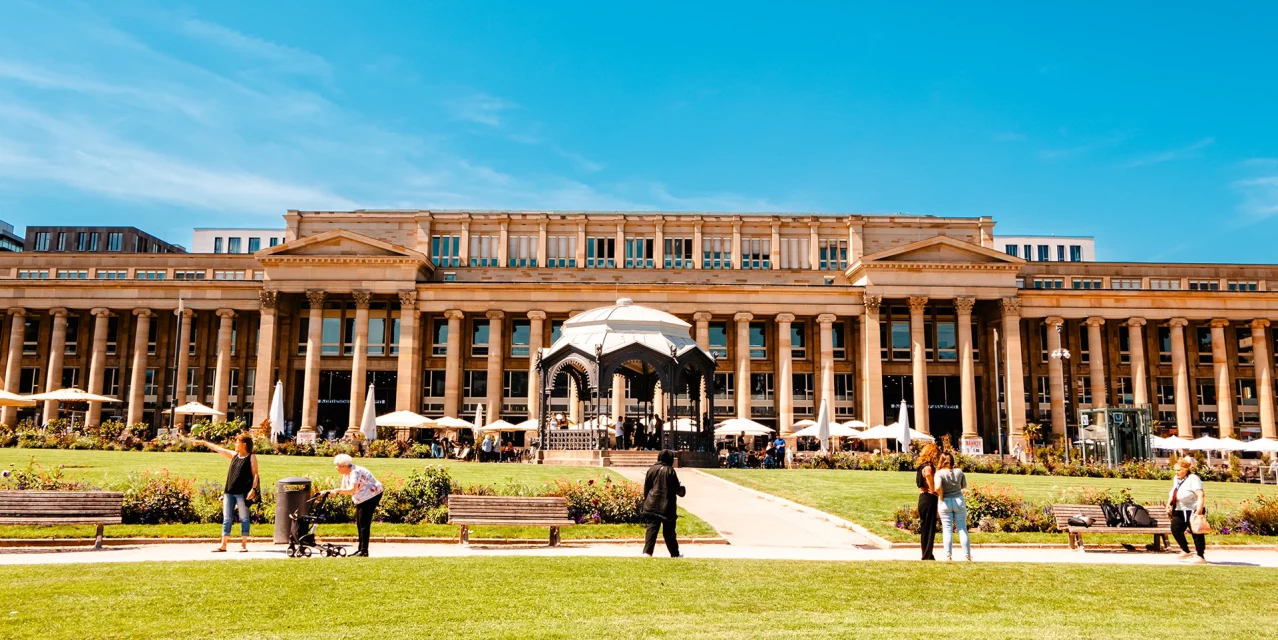
Stores & columns: the royal building
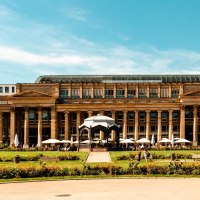
We leave the art museum, head for the Königsbau on the left and stroll through its colonnade. The 34 columns gave the king a headache and earned the Königsbau the nickname "Swabian Acropolis". Who can spot the cast-iron bandstand on the palace square? Tip: take the best photos here.
Mini palace & maxi train station: Bolzstraße
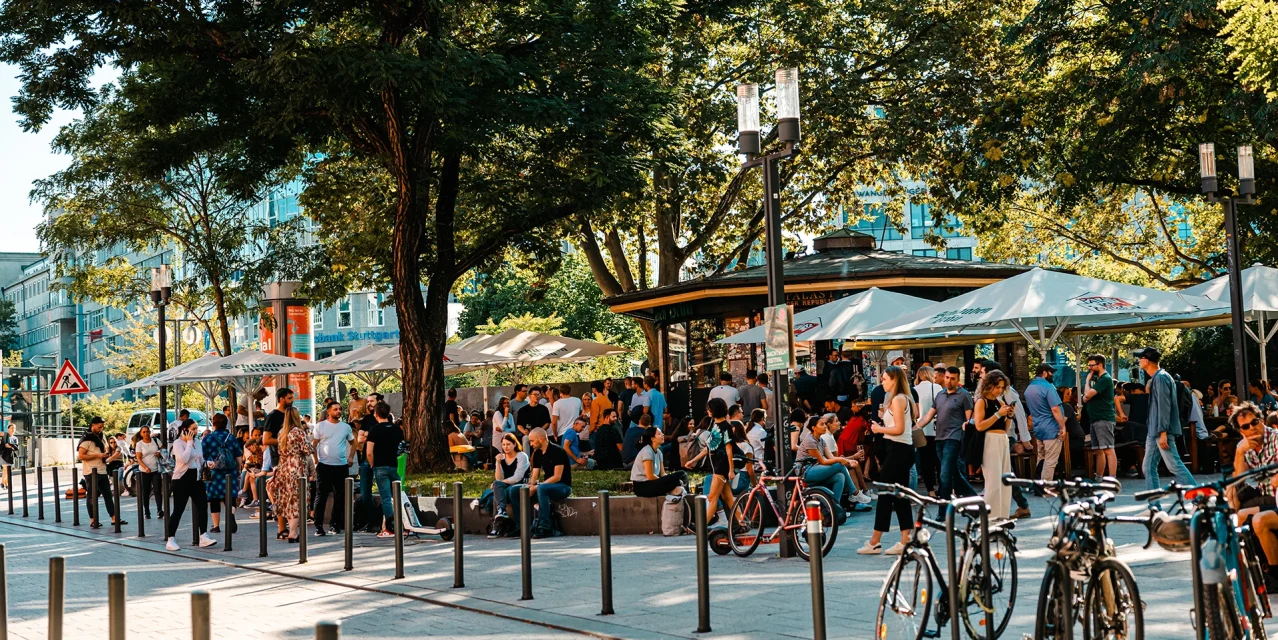
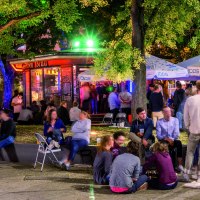
Let's take a quick turn into Bolzstraße. At no. 10, where the Metropol cinema is located today, three of five imposing portal arches are reminiscent of the "Central Bahnhof". If you walk a few steps further, you come face to face with a Stuttgart phenomenon: the Palast der Republik has already had several careers. On warm days, people flock to the small pavilion.
Park & theater: the palace garden
Back to Schlossplatz: we stroll straight ahead, past the Marquardt building, Carl's brewery and the art building on which the golden stag roars. We take another look at the "furnishings" of the Schlossplatz: a guardhouse at the city gate once had to give way to transport the magnificent fountains.
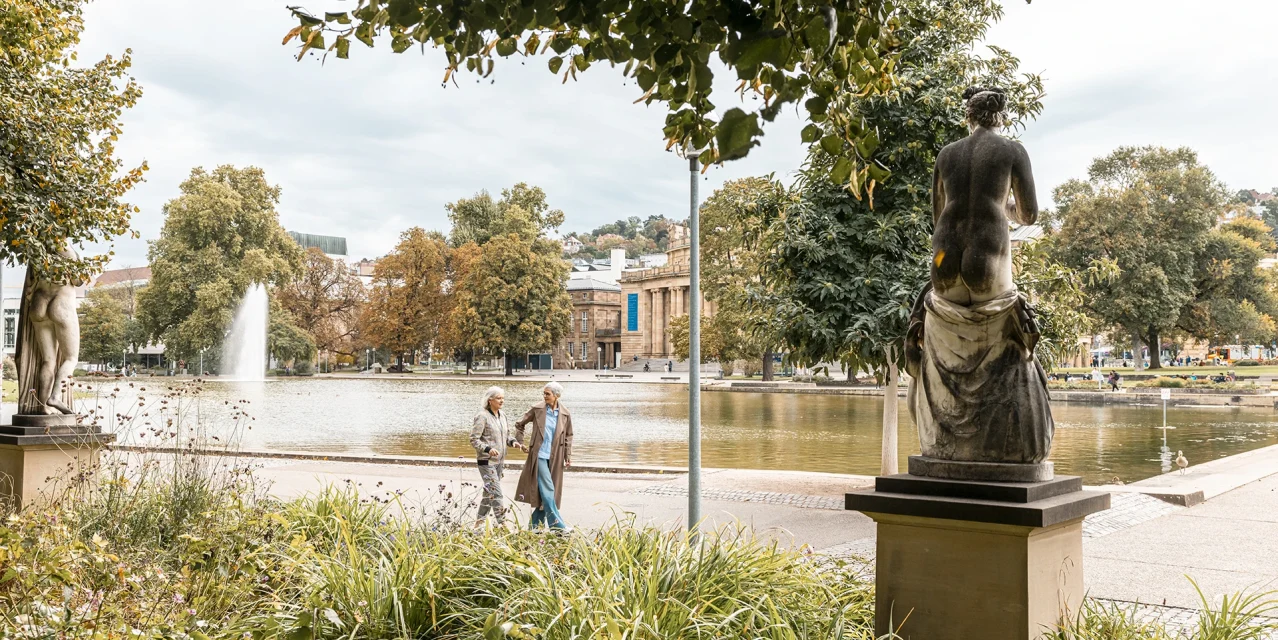
Between the Art Building and the New Palace, we enter the Upper Palace Garden, where the Eckensee lake welcomes us. There we discover the buildings of the Stuttgart State Opera, Schauspiel Stuttgart and Stuttgart Ballet. The cube-shaped state parliament is enthroned next to it. The palace gardens form the start of the Green U, which combines many of Stuttgart's parks into an 8-kilometer-long green corridor. The cultural mile also starts at the State Theater. If you want to discover this, the Bohnenviertel district and the Hans-im-Glück fountain, take a leisurely escapade.
Altes Waisenhaus and Karlsplatz.
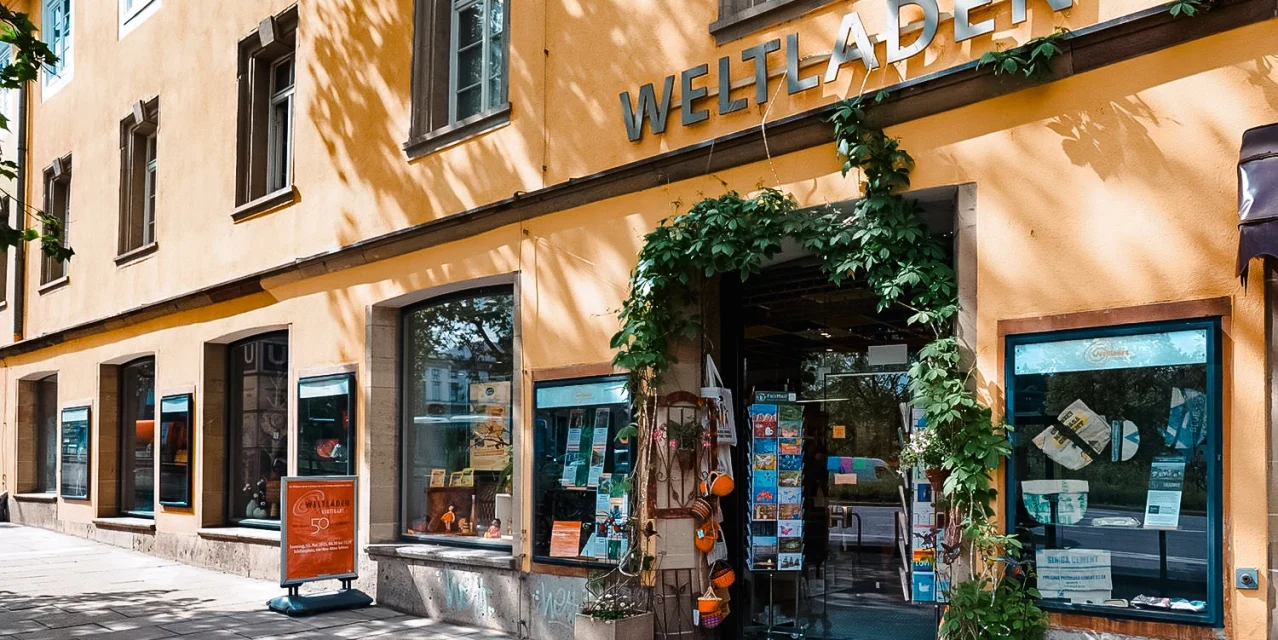
To end our little ramble, we walk along the back of the Neues Schloss through the Akademiegarten, cross the Richard-von-Weizäcker-Planie and come face to face with the Altes Waisenhaus. In the yellow building with its large inner courtyard, the Institute for Foreign Cultural Relations (ifa), the ifa gallery, the Weltladen and the Weltcafé bring together people of all nationalities. We walk across Karlsplatz, where people haggle and dawdle at the flea market on Saturdays. We know these modern facades! That's right: In Karlstraße, we enter the DOQU again. An original Stuttgart shortcut awaits us at Dorotheenplatz. Via Karlspassage, we cross the traditional Breuninger store and marvel at its glass dome. Outside, we turn right and arrive at our starting point, the market square.
Condition of the path
Details
- J
- F
- M
- A
- M
- J
- J
- A
- S
- O
- N
- D
Discoveries along the tour

by Stuttgart-Marketing GmbH